
Will a 5000 Watt Generator Run a Welder?
When it comes to welding, the choice of equipment is critical to the quality and efficiency of the job. One essential piece of equipment in welding is the generator, which provides the power necessary to run welding machines.
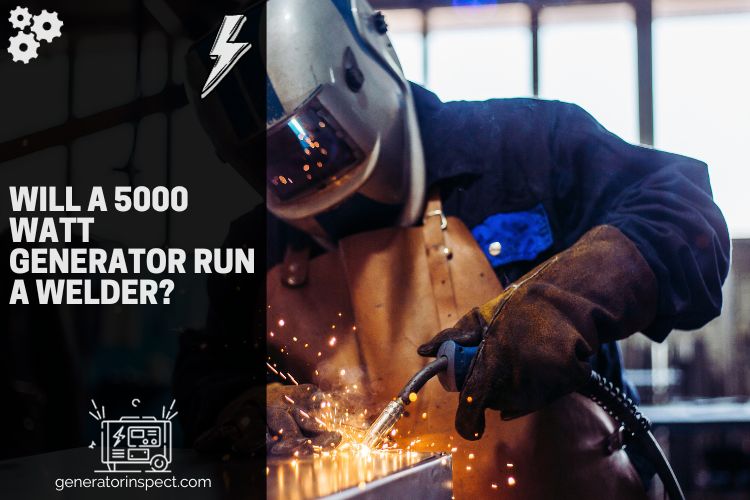
Will a 5000 Watt Generator Run a Welder? Yes, a 5000-watt generator can typically run a welder, but the specific welder’s amperage and voltage requirements should be considered to ensure compatibility.
See Also: Will a 3000 Watt Generator Run a Welder?
Contents
- Will a 5000 Watt Generator Run a Welder? – Guide
- Understanding Generator Sizing for Welders
- Power Supply Differences Between Inverters and Transformers
- Other Factors Affecting Your Choice
- How Long Is the Run Time?
- Generator Sizing Chart for Welders
- Best Generators for Welders
- Smaller Portable Generators
- Conclusion
Will a 5000 Watt Generator Run a Welder? – Guide
Now, we will explore the factors that determine whether a 5000-watt generator is sufficient to power a welder and provide you with practical insights to make the right choice.
Understanding Generator Sizing for Welders
The power requirements of a welder depend on its voltage and amperage. Generators are rated in total watts of power output, while welders are rated for output amperage. To determine whether a 5000-watt generator can run your welder, you need to calculate how many watts your welder needs to produce its rated amps.
Using the Power Equation: Volts x Amps = Watts
To calculate the power requirements of your welder, you can use the simple power equation: Volts x Amps = Watts. Let’s break down the components:
- Volts: Voltage represents the electrical potential difference between two points. Think of volts as the “push” that gets the electricity flowing.
- Amps: Amperes measure the flow of electrical current, similar to the rate of water flow in pipes.
- Watts: Watts measure the heat energy generated as electrons flow through the circuit, creating friction and heat.
Now, to determine the power requirements for your welder, you’ll need to find the input voltage and input current levels specified for your welding machine.
Step 1: Finding the Input Power Levels
To find the power and current levels your welder needs, consult the user manual that came with your welding machine. The manual typically provides information on the required power voltage (V).
For example, consider a welder with an input voltage of 110 volts. To ensure your generator is appropriately sized, add a 15% safety margin to the input voltage:
110 volts + 15% = 126.5 volts
If your welder operates at 220 volts, the calculation would be as follows:
220 volts + 15% = 253 volts
Step 2: Calculating the Input Current
Next, determine the input current (A) required by your welder. The user manual should also provide this information. Let’s use an example:
Suppose the highest input current specified for the 110-volt side of your welder is 46.3 amps.
Now, you can calculate the “running watts” required for this machine:
126.5 volts x 46.3 amps = 5,856.95 watts
However, it’s important to add a safety margin for “starting watts,” typically an additional 30%. So, for the 110-volt welder:
5,856.95 watts + 30% = 5,856.95 + 1,757.09 = 7,614.04 watts
This means you need a generator rated for approximately 7,614 watts running and 8,000 peak watts to run your 110-volt welder. If you want to run the welder on the 220-volt side, you’ll require a generator with higher power ratings.
Alternative Approach: Label Information
If you don’t have access to the manual, check for an information label on your welder. This label is usually located on the rear of the machine or inside the casing and provides details about the welder’s input power requirements.
For example, let’s consider a 120-volt welder that specifies an input current of 23 amps:
120 volts input x 23 amps = 2,760 watts
This calculation provides the basic running wattage required. However, most power tools, including welders, require more power to start than to maintain operation. Therefore, it’s essential to add the recommended 30% safety margin:
2,760 watts + 30% = 2,760 + 828 = 3,588 watts
For this 120-volt welder, you would need a generator rated for at least 3,588 watts running and 3,600 peak watts.
Special Considerations: Tolerance and I1max
Remember to account for any specified tolerance, such as the ±15% mentioned earlier. Always add this tolerance to your calculations.
Additionally, it’s crucial to add the 30% safety margin to your total wattage to cover starting surges, unless you’re using a value known as “I1max.” I1max already includes the maximum starting watts without the need to add an extra 30%.
Input Values with Different Names
Sometimes, you might not find labels specifying “input voltage” or “input current.” In such cases, check for alternative terms, including:
- Input Voltage
- Max Power
- Max Voltage
- V max or Vmax
- U max or Umax
- U1max
- Input Current
- Max Amperage
- Max Current
- A max
- I max
- I1max
The presence of “1max” in the name typically indicates main input power, while “I2” or “I2max” represents output power. Understanding these terms can help you determine the requirements of your welder and generator more accurately.
KVA Rating
Generators are sometimes rated in Kilovolt Amps (KVA), where 1 KVA is equivalent to 1 Kilowatt (KW). To make this conversion, remember the fundamental equation: Volts x Amps = Watts. If you see a generator with a rating of 6 KVA, it’s also rated at 6 KW.
Power Supply Differences Between Inverters and Transformers
One crucial consideration when selecting a generator for your welder is whether your welding machine is powered by a transformer or is an inverter welder. This distinction is essential because generators can produce what is commonly referred to as “dirty power.”
Transformer-Powered Welders
Transformer-powered welders are relatively forgiving when it comes to power quality. Most modern generators can safely run transformer-powered welders.
These generators can provide the necessary power without significant concerns about harmonic distortion, which measures the fluctuations in the power supply.
The robust nature of transformer-powered welders makes them compatible with various generators. They can maintain stable performance even when supplied with less-than-ideal power quality.
Inverter-Powered Welders
Inverter welders, such as IGBT and MOSFET machines, rely on a different technology and are highly sensitive to power quality. These machines often struggle with “dirty power” due to their control circuits, which are susceptible to damage from harmonic distortions in the power supply.
Inverters use capacitors to filter out distortion and smooth the power supply. While this design results in more compact and lightweight welders, it also makes them vulnerable to power quality issues.
Fortunately, many modern generators are equipped with inverter filters, making them safe for inverter-powered welders. However, it’s crucial to ensure that the generator you select offers clean and stable power with low Total Harmonic Distortion (THD) if you plan to use an inverter welder.
THD Rating
To assess the suitability of a generator for powering an inverter welder, pay attention to the Total Harmonic Distortion (THD) rating. THD represents the percentage of harmonic distortion in the power supply. For inverter welders, it’s advisable to choose a generator with a THD rating below 6%. This ensures that the power supplied is clean and safe for your sensitive welding equipment.
Other Factors Affecting Your Choice
When selecting a generator to power your welder, several other factors can influence your decision:
High Altitude Issues
If you plan to use your generator at high altitudes, consider the impact of reduced oxygen levels on engine performance. Gasoline, diesel, and propane engines may become less efficient, resulting in reduced power output. Generator manufacturers typically recommend accounting for a 3.5% power loss for every 1,000 feet of elevation.
To mitigate this power loss, some generator manufacturers offer high-altitude kits that can enhance performance at higher elevations. It’s essential to consider these factors, especially if you plan to weld in mountainous or elevated areas.
Extra Tools and Equipment
In addition to your welder, consider whether you’ll need to run additional tools and equipment simultaneously. Welding is often part of a broader project that may require the use of saws, grinders, drills, and other power tools. Each of these tools has its power demands.
For instance, many grinders and reciprocating saws can consume as much as 1,800 watts of power to operate. Additionally, consider other electrical devices, such as fans, heaters, and lighting, that may be necessary for your workspace.
It’s important to assess the combined power requirements of all the equipment you plan to use in conjunction with your welder. In some cases, it may be more cost-effective to invest in a separate generator for running these auxiliary devices, rather than overloading a single generator.
How Long Is the Run Time?
The run time of a generator refers to how long it can operate continuously at full power with a full tank of fuel.
The run time varies among generators, with some models capable of running for 8 to 10 hours, while larger generators may only last a couple of hours between refills, especially when operating at full capacity.
When selecting a generator, consider your specific welding projects and the expected duration of your work. A longer run time can be particularly advantageous when working in remote locations where refueling may be inconvenient.
Noise
Generators are known for their noise output, although they are generally not as loud as some industrial tools and vehicles. When using a generator for welding, it’s essential to account for noise levels, especially if you’re working in noise-sensitive environments.
Generators typically come with noise ratings measured in decibels (dB). As a reference, noise levels above 90 dB are considered damaging to hearing, while ratings exceeding 120 dB are equivalent to deafening sounds like those produced by drag racers, artillery, jet aircraft, or hunting rifles.
Ensure that your chosen generator’s noise output is compatible with your work environment and local noise regulations. If necessary, consider using additional sound insulation or relocating the generator to minimize noise disturbances.
Placement
Proper placement of your generator is crucial for both safety and functionality. Generators should never be placed indoors due to the risk of carbon monoxide poisoning. Instead, generators should be positioned in well-ventilated areas.
When determining the placement of your generator, consider the following:
- Adequate ventilation to disperse exhaust fumes
- Protection from potential collisions or falling objects
- The ability to safely extend power cords to your work area
- Noise levels and the potential impact on your work environment
It’s also important to comply with safety guidelines provided by the generator manufacturer regarding proper placement and ventilation.
Generator Sizing Chart for Welders
To simplify the process of selecting the right generator for your welder, refer to the following sizing chart. This chart provides guidance based on the current level of your welder and suggests minimum and recommended generator sizes.
| Welder Current Level | Minimum Generator Sizing | Recommended Generator Size |
|---|---|---|
| Up to 160A | 7kVA or 7000 watts | 8000+ watts |
| 180–200A | 8kVA or 8000 watts | 10,000+ watts |
| 210-250A | 13kVA or 13,000 watts | 15,000+ watts |
The chart offers a quick reference to help you determine the appropriate generator size based on your specific welding machine’s current level.
Best Generators for Welders
Now that you understand the key factors in selecting a generator for your welder, let’s explore some of the best generator options available.
When it comes to powering your welding equipment, it’s essential to choose a generator that offers clean and consistent power, minimizing wear on your equipment and ensuring longer service life.
Substantial Portable Generators
For powering your welder, it’s advisable not to choose a generator that operates near its power limit. Opt for a generator that provides cleaner and more consistent power, as this reduces wear and extends the life of your equipment. Therefore, we recommend not going below 7,000 running watts for your welding projects.
Champion 9375
- Running Watts: 7,500
- Starting Watts: 9,375
- Weight: 224 lbs
- Engine: Champion 420cc
- IGBT-Safe: No (8-16% THD)
- Outlets: – 120/240V 30A locking (L14-30R), (2) GFCI 120V (5-20R), 120/240V 50A (14-50R)
- Run Time: 8 hours at 1/2 load
- Noise Level: 74 dB
- Extras: Electric start, wheel kit, hours meter
DuroMax XP12000EH
- Running Watts: 9,500
- Starting Watts: 12,000
- Weight: 224 lbs
- Engine: DuroMax 18 HP
- IGBT-Safe: No (12% THD)
- Outlets: (2) 120V household GFCI outlets, (1) 120V 30A twist-lock outlet, (1) 240V 30A outlet, (1) 240V 50A outlet
- Run Time: 9 hours at 1/2 load, 5 hours at full load
- Noise Level: 74 dB
- Extras: Electric start, dual fuel, wheel kit, 12V battery charger
Powerhorse 9000ES
- Running Watts: 7,250
- Starting Watts: 9,000
- Weight: 209 lbs
- Engine: Powerhorse 12.2 HP
- IGBT-Safe: Yes
- Outlets: (4) 5-20R 120V-20A, (1) L5-30R 120V-30A locking, (1) L14-30R 120/240V-30A locking, (1) 12V DC
- Run Time: 9.6 hours at 1/2 load, 5.7 hours at full load
These substantial portable generators provide the power and reliability necessary to run your welder without pushing the equipment to its limits. Their clean and consistent power output minimizes wear and extends the life of your welding equipment.
Smaller Portable Generators
If you own a smaller welder or need a more compact and portable generator, the following options are suitable for a wide range of welding machines.
Honda EU2200i
- Running Watts: 1,800
- Starting Watts: 2,200
- Weight: 46.5 lbs
- Engine: Honda GXR120
- IGBT-Safe: Yes
- Outlets: (2) 120V 15A
- Run Time: Up to 8.1 hours at 1/4 load
- Noise Level: 48-57 dB
The Honda EU2200i is known for its quiet operation and clean power output, making it ideal for inverter welders with lower power requirements.
Briggs & Stratton P2200 Power Smart Series
- Running Watts: 1,700
- Starting Watts: 2,200
- Weight: 55 lbs
- Engine: Briggs & Stratton 111 cc
- IGBT-Safe: Yes
- Outlets: (2) 120V 20A
- Run Time: Up to 8 hours at 1/4 load
- Noise Level: 59 dB
The Briggs & Stratton P2200 is a compact and portable option, providing reliable power for smaller welders and inverter machines.
Conclusion
Selecting the right generator to run your welder is a critical decision that can greatly impact the quality and efficiency of your welding projects. To determine if a 5000-watt generator will suffice, you must calculate the power requirements of your specific welder, taking into account voltage, amperage, and safety margins.
In addition, it’s important to consider the type of welder (transformer or inverter), Total Harmonic Distortion (THD), altitude, extra equipment, run time, noise, and proper placement. Ensuring that your generator provides clean and consistent power is essential to extend the life of your welding equipment and produce high-quality welds.
By understanding these factors and exploring the generator options available, you can make an informed decision to power your welder effectively and efficiently, ultimately achieving better welding results.
Read Also: Where Is the Exhaust on a Generac Generator?


